
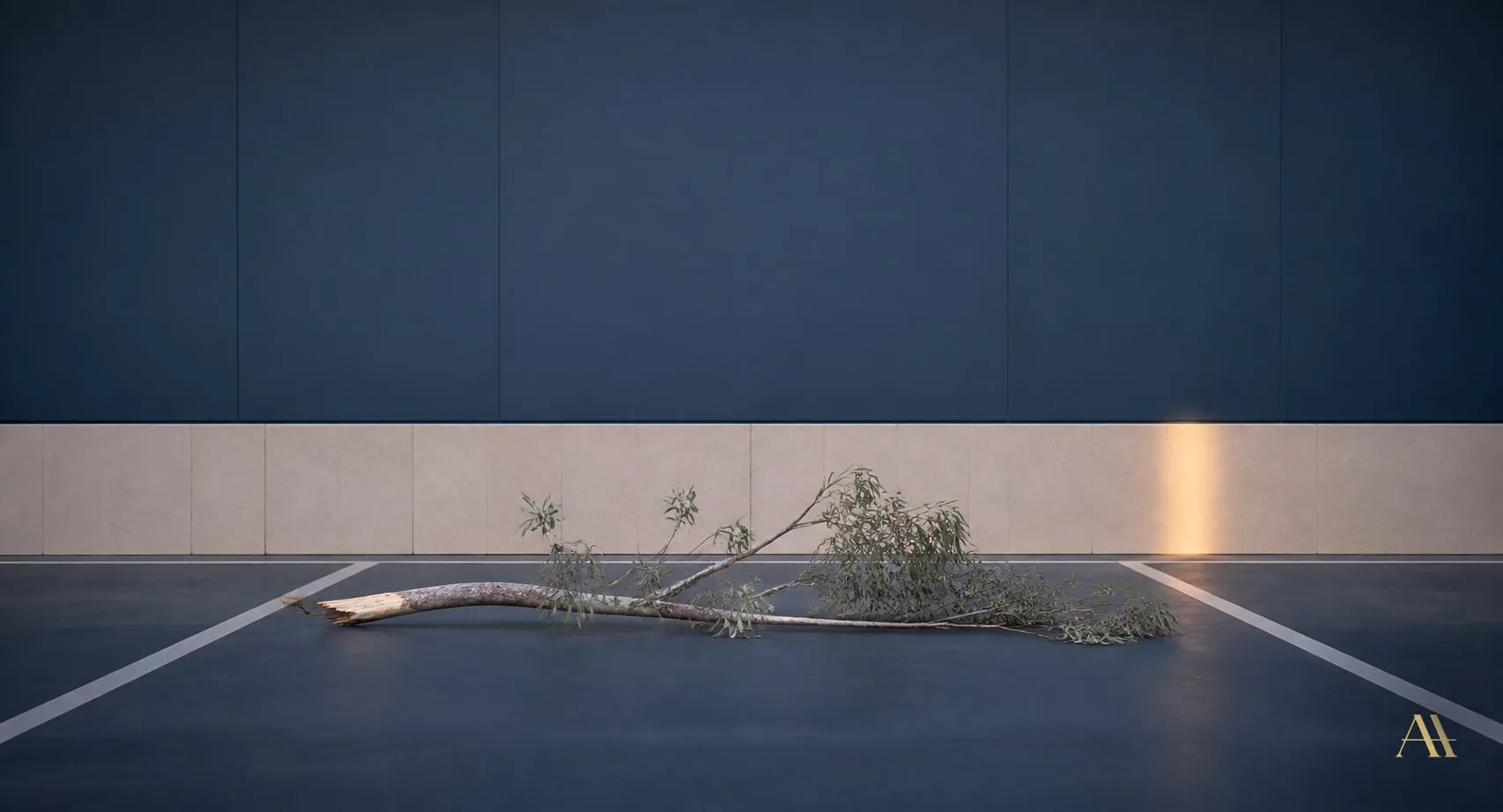
Description of the incident: a woman parked her vehicle near her home, beneath a large eucalyptus tree with many branches, and in the morning noticed that branches had fallen from the tree onto the roof of the vehicle, causing damage that led to its being declared…
In its statement of defense, the local authority argued that on the day of the incident there was a storm accompanied by strong winds, and that this therefore constituted force majeure over which the local authority had no control whatsoever, and that two weeks before the incident the municipality had pruned the trees on the street in question.
To the circumstances of the incident it should be added that, after the incident, a municipal representative arrived and asked to whom the vehicle belonged; but since there was a power outage in the area and the woman could not leave her home owing to the heavy rainstorm, she waited until the morning to inspect the damage caused to the vehicle.
To her surprise, the woman discovered that the branches that had struck the vehicle had been removed from the site, creating an evidentiary difficulty in linking the damage caused to the vehicle to the local authority.
Shifting the burden of proof
The woman argued that the burden of proof should be shifted onto the local authority in view of the “res ipsa loquitur” rule (the thing speaks for itself) and in accordance with the provisions of Section 41 of the Torts Ordinance – New Version.
Section 41 of the Torts Ordinance (New Version) provides:
“In an action brought for damage, where it is proved that the plaintiff had no knowledge, or had no means of knowing, what were in fact the circumstances that caused the occurrence which led to the damage, and that the damage was caused by property over which the defendant had full control, and it appears to the court that the occurrence of the event that caused the damage is more consistent with the conclusion that the defendant did not exercise reasonable care than with the conclusion that the defendant did exercise reasonable care — the onus is on the defendant to prove that there was no negligence on his part in respect of the event that led to the damage, for which he would be liable.”
Does a tree falling on a vehicle indicate negligence?
The court held that it cannot be said, in absolute terms, that a tree falling is more consistent with negligence on the part of the local authority than with the absence of negligence, and ruled that the burden of persuasion should be shifted to the local authority to show it had not caused the damage.
What preceded the court’s decision to shift the burden of persuasion was an event whose existence the local authority itself confirmed — namely, the pruning of the tree two weeks before the storm — and it is quite possible that branches remained on the tree that could be linked to the damage to the vehicle.
The court further held that the manner in which the local authority handles the trees within its jurisdiction, and the way it prepares for a rainstorm, lie by their very nature within the local authority’s knowledge, and that in these circumstances the “special knowledge rule” applies to the local authority. That rule provides that where the information lies within the defendant’s exclusive knowledge, it is sufficient for the plaintiff to meet a light burden of adducing prima facie evidence in order to shift the burden of adducing evidence onto the defendant.
Since the municipality did not trouble to bring evidence to refute the woman’s claims, and did not even document the removal of the branches from her vehicle, it caused evidentiary harm — something that made it difficult to examine the hazard in real time — and the court therefore held that the municipality had failed to prove that it had not been negligent in the ongoing supervision and maintenance of the trees.
Can the municipality rely on a claim of force majeure?
The municipality argued that on the day of the incident there was particularly stormy weather that constituted force majeure and exempted it from liability toward the woman for any damage caused to her vehicle. To establish its claim, the municipality decided to bring an expert opinion.
The expert’s opinion was “full of holes” and included no reference to the frequency of stormy weather in the area in previous years, and the expert’s statements were unsupported and could not be verified. In light of the municipality’s problematic line of defense, the court held that the municipality’s claim of force majeure had not been proved.
In conclusion
The court ruled in the woman’s favor for the full amount of the damage and imposed full liability on the municipality and on the pruner it had employed.
Recommendations
If you have suffered damage and it is difficult to prove the extent of the local authority’s liability in the absence of evidence, this should not prevent you from trying to impose liability on the basis of the rules mentioned above.
In addition, it should be checked whether the local authority carried out its work faithfully and prepared in good time for the winter season, so that you are not necessarily responsible for the occurrence of the damage.
And a final recommendation by way of summary: try not to park your vehicle beneath trees during the winter season, because it is better to prevent the damage in advance.